What to Know About Bear Canister Requirements on the A.T. in Georgia
Nov 12, 2026

Nov 12, 2026

The USDA Forest Service has issued an order making bear canisters required for anyone camping along the Appalachian Trail (A.T.) in Georgia year-round effective January 1, 2027.
As the land management agency responsible for the entire A.T. in the state, the Chattahoochee-Oconee National Forest alone has the authority to issue orders, bans, and closures along the Trail in Georgia.
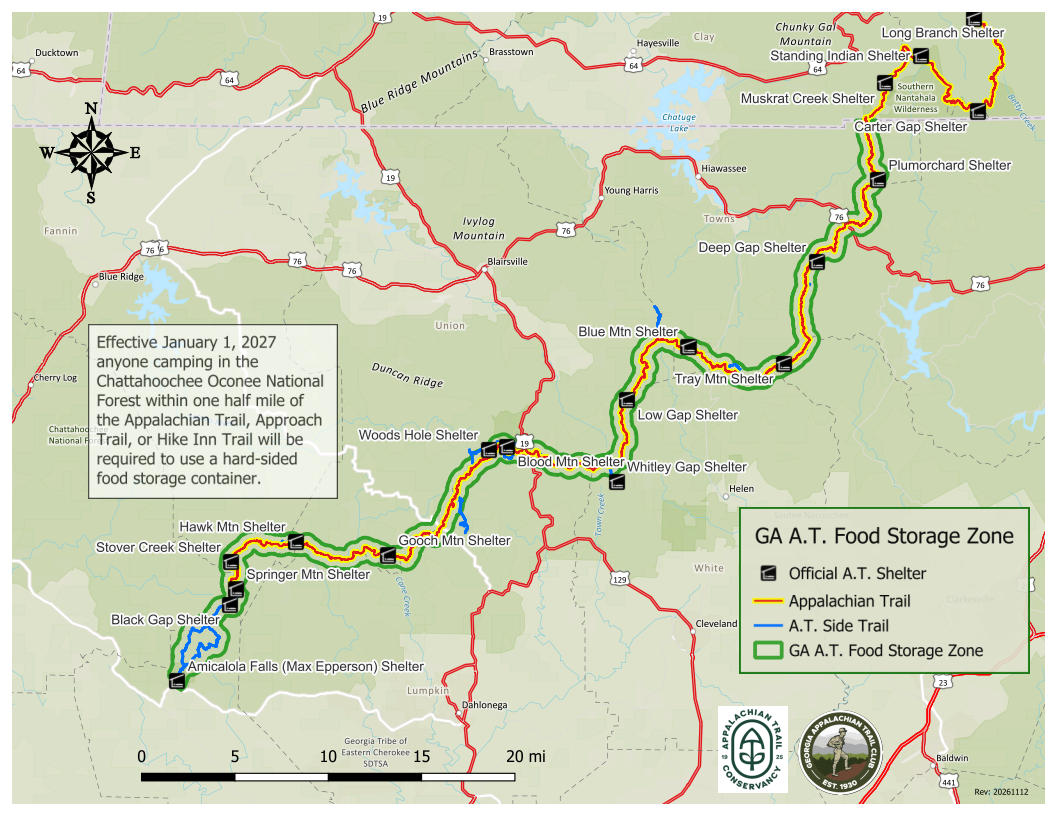
The new food storage order requires anyone camping overnight within a half mile on either side of the A.T. to store food, food containers, trash, and toiletries in a hard-sided bear canister.

The Appalachian Trail Conservancy (ATC) has gathered info and resources here for hikers to help protect yourself, other hikers, and bears while on the A.T. in Georgia.
Human-bear conflict has been on the rise on the A.T. in Georgia over the past two decades. Despite increased education about proper food storage and food storage devices installed at all designated overnight sites on the A.T. in Georgia, preventable food-storage mistakes continue to attract bears. This is primarily a human caused problem, due to increasing visitation and A.T. campers not keeping a clean camp and/or improperly storing their food.
A fed bear is a dead bear. Hard-sided bear canisters have shown to be the most reliable, efficient, and flexible method of food storage on the A.T., protecting both humans and bears. Bear canister requirements have also shown to be effective at reducing human-bear conflict along other popular trails in the East. For example, within the first four years after the bear canister requirement went into effect in the Adirondacks, the Wildlife Conservation Society found that bear conflict reports decreased by 80%.
The order includes the entire Appalachian Trail in Georgia, all national forest lands within a half mile of the A.T., the A.T. Approach Trail, the Len Foote Hike Inn Trail, all other side trails within the half-mile buffer, as well as all A.T. shelters and campsites within the half-mile buffer (NOBO mile 0 to 78.3).
Per the order, any “commercially made bear resistant canister, constructed of solid, non-pliable material, manufactured for the specific purpose of resisting entry by bears” is acceptable.
The following canisters are compliant with the order:

The bear canister requirement is an official Forest Service order. Those who do not follow the order can be ticketed and fined.
Yes, you can still put your bear canister in the provided bear boxes if there’s room.
We do not recommend hanging your bear canister from cables. Bear canisters are designed for on-ground use, to withstand the onslaught of bears’ claws and jaws. They are not designed to withstand loaded drops from high up in trees. If you do use bear cables, put the canister in your empty pack and hang your pack from the cables.
Keep in mind during high traffic periods, bear boxes and cables may fill up. If this is the case, we recommend placing your canister near the bear box.
No, the food storage order requires anyone camping overnight along the A.T. in Georgia to use a hard-sided bear canister. Day hikers should still never leave food unattended and always pick up trash and food scraps.
Each manufacturer has instructions for its product. The ATC has tips on how to use BearVault bear canisters.
All food, food waste, trash, cookware, toiletries, and other “smellables” should go into your bear canister overnight.
Smellables are items that aren’t necessarily edible but have a scent that could attract animals. This includes toothpaste, chapstick, bug spray, sunscreen, hand sanitizer, WAG bags (bags that have a gelling agent in them for pooping in when privies aren’t available and you can’t dig a cat hole), some medications, etc. Even products branded “unscented” may still have an odor for animals.
For a complete list, see the ATC bear canister use tips.
When you are ready to store your canister for the night, first be sure it is closed and locked.
We recommend grouping canisters together at busy overnight sites. At overnight sites with bear boxes, put your canister in or around the bear box. At overnight sites with cables, look for signs indicating where to store canisters (Trail managers will be putting these up over winter). Make sure your canister is clearly marked with your name or easily identifiable as yours with stickers, reflective tape, etc.
At sites without a bear box or cables, it is still better to group canisters together if there are other people staying there. Use the “Bearmuda Triangle:” Store canisters 200 feet or 70 big steps from where people sleep, where people cook/ wash dishes, and where you put your canisters.

Bear canisters come in a variety of shapes and sizes. For proper balance and comfort, place the canister in the center of your pack and close to your back.
Try these tips from BearVault:
If you haven’t purchased a pack yet, make sure to get one large enough to fit your canister of choice. Many outfitters and retailers will allow you to test different packs with different weights, so you can bring your canister to try out different packs.
Bear canisters are available at most national outdoor stores and outfitters and directly through manufacturers. These local outfitters in Georgia also sell bear canisters. We recommend calling ahead to verify supply:
You can rent a bear canister at these local locations:
Rental programs that ship nationwide:
No matter where you are on the A.T., the ATC strongly recommends overnight hikers use bear canisters. Proper bear canister use has shown to be the most effective, efficient, and reliable method of food storage on the Trail.
Learn more about proper food storage, bear safety, and how to report bear encounters on our Bear page.

Featured photo courtesy of BearVault.