Why Aren’t There More Bear Boxes on the Appalachian Trail?

Aug 27, 2026

Aug 27, 2026

This is the second story in our series inspired by the NPR segment “But Why?”, where we answer your most common questions about how the Appalachian Trail (A.T.) is managed.
The increase in human-bear conflict along the A.T. and the Appalachian Trail Conservancy’s (ATC) 2022 policy to encourage bear canister use have prompted many to take a new look at food storage on the A.T. In this blog post, ATC Information Services Manager Caitlin Miller talks with other ATC staff and an A.T. volunteer to answer the common question:
The A.T. provides excellent habitat for American black bears, which live in all 14 states that the Trail passes through. Bear populations along the A.T. have increased dramatically since the 1990s – in some states like Virginia, upwards of 500%.
While black bears are naturally shy and scared of people, they are also highly intelligent and curious. Successfully getting human food and trash can cause them to lose their fear of people and lead to aggressive, dangerous behavior. Unfortunately, negative human-bear encounters are becoming more frequent along the Trail, with a 75% increase in bear encounter reports in 2025.
A “footpath for those who seek fellowship with the wilderness,” there are a few key documents that lie at the core of all management decisions along the A.T. The ATC, volunteers, and partners are obligated to follow the management philosophy they outline. One guiding document is the Appalachian National Scenic Trail Comprehensive Plan.
“The Trail is supposed to be as natural as it can be,” explains Morgan Sommerville, the ATC’s Director of Visitor Use Management. “Getting back to Benton MacKaye’s original idea, it’s supposed to be as removed and separate from modern society and its trappings as possible.”
The Comprehensive Plan directs the ATC and our partners to manage the A.T. such that hikers “must be responsible for their own safety and comfort” (Comp. Plan, pg. 6). The benefits of installing any new food storage devices on the A.T. must be weighed against how doing so will impact both the self-reliance of hikers and the wildness of the Trail.
Those who really want an “unregimented atmosphere” (Comp. Plan, pg. 7) can find just that on over half of the A.T., where dispersed camping is allowed (camping not restricted to signed, managed shelters and campsites). Some well-used dispersed campsites may seem like managed sites—they have fire rings, maybe even little log benches—but they aren’t; those things were left by other hikers. The ATC, Clubs, and partners do not maintain them and don’t provide any facilities at dispersed sites.
“Bears have a shockingly keen sense of smell and roam up to 50 miles a day in search of food,” Sommerville said. “The A.T. Clubs, ATC, and land managers cannot provide food storage devices for every place someone may choose to camp.”

While documents like the Comprehensive Plan guide overall management strategies for the A.T., there is of course variability. Kathryn Herndon-Powell, the ATC’s Regional Director of the Virginias, points out: “There’s not a one-size-fits-all, set-it-and-forget-it solution for the Trail.”
“Any additional infrastructure needs to be maintained,” Herndon-Powell said. “Every time we add something, it’s a conversation with all our Cooperative Management System partners.”
Volunteers with the Roanoke Appalachian Trail Club (RATC) maintain over 120 miles of the A.T. around Virginia’s Roanoke and New River valleys. With Virginia having the highest number of bear reports, RATC is an A.T. Club that necessarily has a varied approach to managing human-bear conflicts, and has overnight sites both with and without provided food storage devices.
Linda Mulheren, RATC’s President, shares one example of an A.T. section where it made sense to install bear boxes.
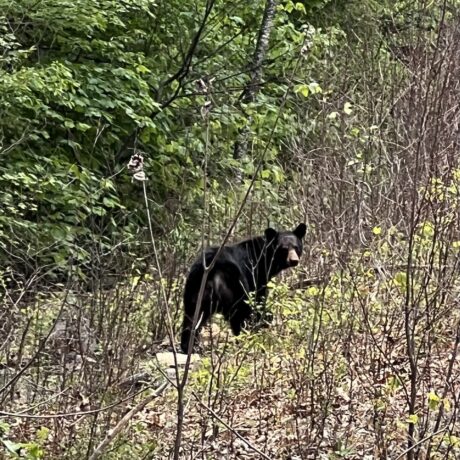
Bear near McAfee Knob, VA.
“We have really high-use shelters in the Triple Crown area, with lots of casual overnighters who aren’t as familiar with backcountry food storage practices – they’re novices,” Mulheren said. Adjacent protected land in Carvins Cove provides additional bear habitat, so the Triple Crown has a relatively large bear population. This confluence of local considerations motivated managers to install the boxes.
In other sections, installing food storage devices may not align with management plans or may not be warranted by Trail use or conditions. Linda points out that RATC does not have any bear boxes in Congressionally designated Wilderness areas.
Wilderness areas have an additional layer of protection that directs managers to prioritize natural, untrammeled character and provide relatively unrestricted opportunities for non-motorized recreation and solitude. Herndon-Powell notes A.T. shelters only exist within Wilderness areas because they were built prior to Wilderness designation and grandfathered in. “We have quite a few overnight sites within Wilderness in Virginia. They may look and feel just like other shelters along the Trail, but those areas are managed for a more primitive experience. There are additional decision-making processes when it comes to adding any infrastructure there, such as a bear box.”
Designated Wilderness is just one example. Between 14 states, six National Park units, eight National Forests, and hundreds of state, local, and municipal lands, plus varying levels of visitor use and bear population density, decisions about food storage devices are different from Maine to Georgia.
Even if an overnight site has provided food storage, that does not mean the device will be usable when you arrive at camp.
Bear cables require perhaps the most maintenance, and hikers have arrived at camp counting on using cables only to find them broken; additionally, in some locations flying squirrels have raided food bags on cable systems. Bear boxes are too often left with trash or discarded food items left as “trail magic,” taking up valuable storage space and attracting ants and mice. Bear poles don’t require as much maintenance but may be difficult for some visitors to use. They are also not critter proof – ATC has received reports of raccoons raiding food bags on a bear pole in Pennsylvania!
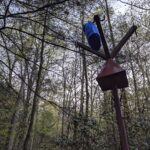
Even if the device is functional, it may be full by the time you arrive. ATC Ridgerunners this year in Georgia reported northbound thru-hikers racing to shelters each day to ensure there was space in the bear box for their food, and elsewhere along the Trail, a single large group can take up nearly all the available space in a bear box.
Installing bear boxes, cables, and poles takes time, money, and effort (some remote areas even require they are flown in via helicopter, adding thousands of dollars to the total cost). Moreso, though, they require ongoing maintenance. While these devices are very effective when they are working correctly and should be used when available, there’s no guarantee they’ll be usable.
Hikers should be prepared with their own way to properly store their food at night, no matter where they’re headed on the Trail.
Despite food storage at every designated overnight site, the McAfee Knob area still sees visitors storing their food improperly and leaving food and trash behind. Mulheren shared some examples of poor food storage practices that the RATC sees regularly in their section.
“People don’t realize that anything with a scent needs to go in the box. Other common behaviors are people leaving food on the picnic table to check out a view, and even just not wanting to walk up to the bear box in the evening,” Mulheren said.
“They think the worst thing that happens is they lose their food. But there’s this huge downstream impact on the bear and the hikers that stay after you.”
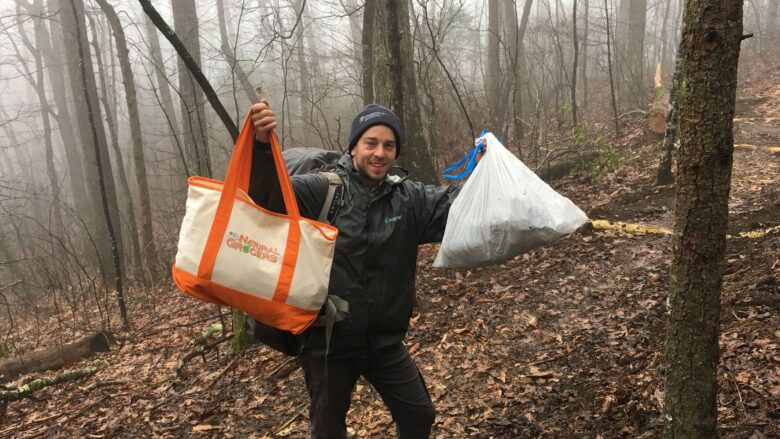
Trail maintainers pack and haul out left behind trash.
These issues happen all along the Trail where food storage devices are provided. Despite each overnight site having bear cables, there are shelters closed each year in Great Smoky Mountains National Park due to bears becoming conditioned to human food. Even with bear boxes at each overnight site on the A.T. in Georgia, Ridgerunners report hikers just not using them, resulting in annual reports of human-bear conflict each spring. Plus, maintainers often find bear boxes filled with trash or “trail magic,” making them unusable for hikers, and bear cables can break, making it important that hikers are always prepared to safely store their food themselves.
Just as you’re responsible for packing your own first aid kit in case you get hurt or bringing a rain jacket in case the weather turns, you also must be responsible for properly storing your own food, trash, and scented items.
“This is a human problem, not a bear problem,” Sommerville sums up. “Until humans take food storage seriously, no amount of boxes will solve that.” It’s up to everyone that visits the Trail to protect themselves, other hikers, and the bears that call the A.T. home by learning about proper food storage and bringing the gear you need to do it.
The ATC strongly recommends all A.T. hikers use hard-sided bear canisters for backpacking on the Trail, as canisters have shown to be the most reliable, efficient and effective method of food storage for anywhere on the Trail. Visit our Bear page to learn more about how to use bear canisters, food storage and bear safety on the A.T.
You can also become an A.T. volunteer to help protect the Trail and be part of management decisions like these.

Morgan Sommerville is an A.T. 2,000-miler, having hiked all but 300 miles of the Trail in 1977 – finally finishing in 2000. He started his trail management career as a backcountry ranger in Great Smoky Mountains National Park before joining ATC in 1983. He’s seen firsthand the rise of human-bear conflict on the Trail and has worked to reduce those conflicts through data-backed management strategies.
Kathryn Herndon-Powell thru-hiked both the A.T. and the Pacific Crest Trail before starting with the ATC in 2011 as a crew leader for the Konnarock Trail Crew. She’s spent 15 years working along the A.T. in Virginia and collaborating with partners to reduce human-bear conflicts along some of the Trails’ busiest sections.
Linda Mulheren has been an A.T. volunteer since her early twenties, first with the Tidewater Appalachian Trail Club and the Potomac Appalachian Trail Club. After her 2016 A.T. thru-hike, she moved to the Blacksburg area and joined RATC. She creates Trail signs, does boundary monitoring, and maintains her own section of Trail along with being the Club president. She serves on ATC’s Stewardship Council as part of the Trail Management Committee.