A.T. Volunteer Impacts in 2026
Oct 19, 2026

Oct 19, 2026
The Appalachian National Scenic Trail benefits from a vibrant and robust volunteer network coordinated by the Appalachian Trail Conservancy in collaboration with 30 deeply committed A.T. Clubs who maintain the Trail from Georgia to Maine.
In the 2026 federal fiscal year, 4,712 volunteers spent 164,186 hours caring for the Appalachian Trail. That’s an incredible investment of time, talent, and energy! Together, these volunteers provided the equivalent of $5.9 million in labor.

A.T. Club volunteers contributed much of this effort. Club volunteers keep the treadway safe and sustainable, maintain shelters, bridges, and other structures, protect natural resources, and remove invasive species, among many other responsibilities. The Appalachian Trail Conservancy (ATC) supports keeping volunteers at the forefront of A.T. management by providing resources, training, technical guidance, and opportunities to connect and share knowledge.
The ATC is grateful for the dedicated volunteers who are the heart of A.T. stewardship. The stories and accomplishments highlighted here are just a sampling of the immeasurable ways volunteers contributed to the A.T. from October 1, 2025 through September 30, 2026.

Horizonline Pictures
The Tennessee Eastman Hiking and Canoeing Club continued extensive Hurricane Helene (2024) recovery efforts, including blowdown removal, root ball rehabilitation, treadway repairs, vegetation clearing, and step rebuilding between Cherry Gap and Iron Mountain Gap. The section reopened following collaborative work by TEHCC, the Appalachian Trail Conservancy, and the USDA Forest Service.
Since Hurricane Helene damage closed the Virginia Creeper National Recreation Trail, which co-aligns with the A.T. north of Damascus, VA, the Mount Rogers Appalachian Trail Club has kept hikers safe by managing and maintaining a significant detour this past year.
After a severe July storm caused extensive damage, volunteers with the Appalachian Mountain Club – Connecticut Chapter quickly cleared 12 miles of Trail between Falls Village and Salisbury, CT, ensuring that the A.T. remained open and safe during peak hiking season.
In December, the Carolina Mountain Club and the Georgia Appalachian Trail Club logged more than 2,000 hours rebuilding a storm-damaged rock staircase near I-40 with 72 erosion-resistant stone steps, each weighing 500 pounds. The Jolly Rovers Trail Crew and the GATC offered technical rock work training, and the ATC’s Appalachian Trail Resiliency Fund provided financial support for the project. Several volunteers with the Smoky Mountains Hiking Club also contributed time to the project.
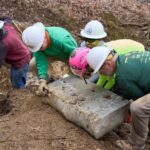
David Huff and Carolina Mountain Club
In September, the BATONA Hiking Club & the ATC’s Mid-Atlantic Trail Crew completed the Wind Gap reroute after four years of work, replacing a steep section of the Trail with sustainably constructed switchbacks.
The Allentown Hiking Club worked with the Mid-Atlantic Trail Crew, the Pennsylvania Outdoor Corps, and a local business to relocate a section of the Trail away from a busy road and to replace a set of stairs near the road.
In June, the Georgia Appalachian Trail Club celebrated the completion of the new Byron Reece Trail, a 1.2-mile trail connecting the trailhead parking near Neel Gap to the A.T. on Blood Mountain. This new trail was built over a period of three years with work by GATC volunteers and assistance from the ATC’s professionally led, volunteer-driven Konnarock Trail Crew.

Laura Fitzmorris
The Nantahala Hiking Club partnered with the USDA Forest Service and the ATC to install a 200-pound bear box at the Muskrat Creek Shelter in response to bear activity.
After two years of planning, design, and construction, the Natural Bridge Appalachian Trail Club opened a new moldering privy at Priest Shelter.
The Piedmont Appalachian Trail Hikers completed the Lynn Camp Creek bridge project after several years of work by Club volunteers and partners. The Club was able to use the original bridge stringers and decking.
The Appalachian Mountain Club – Delaware Valley Chapter replaced the roof on their informational kiosk at Fox Gap in Pennsylvania.
The York Hiking Club made significant repairs to the Clarks Ferry Shelter area, including repainting the shelter, repairing the privy, creating replacement signage for the water source, and rehabilitating the tent camping area.
The Maine Appalachian Trail Club replaced three backcountry privies; part of a multi-year project to upgrade 42 privies along the Trail in Maine. This year’s three projects were each located at high altitude sites and required a helicopter airlift to deliver construction materials and tools.
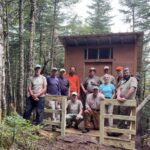
Maine Appalachian Trail Club
The New York-New Jersey Trail Conference’s Long Distance Trails Crew installed 150+ steps and hundreds of square feet of retaining walls and cribbing to repair the heavily-eroded section of the A.T. at Agony Grind in New York.
In Maryland, Potomac Appalachian Trail Club crews installed dozens of stone check dams, water bars, and stone steps on steep portions of the A.T. near Washington Monument State Park. On the Garvey Shelter–Weverton Road section, a group of 10 volunteers installed 17 stone check dams and steps. The Club also completed the Virginia approval process for a new privy design, advancing construction of the replacement privy at David Lesser Shelter, and finished the long-planned improvements to the VA 725 A.T. parking area.
The Keystone Trails Association, in partnership with the Cumberland Valley Appalachian Trail Club, officially closed on the Scott Farm property in Carlisle, PA, after eight years of work. The property will house KTA’s administrative offices and provide a welcoming outdoor recreation hub, serving A.T. visitors.
In partnership with the ATC, the Smoky Mountains Hiking Club assisted with a helicopter airlift that delivered logs and other materials to improve the treadway and enhance the overall A.T. experience for hikers in the Great Smoky Mountains National Park. Shelter repair materials were also delivered to address deficiencies at Silers Bald Shelter, a major Club project scheduled for completion in October. Additionally, the Club completed its log installation project at Icewater Spring Shelter, funded by the Tennessee A.T. License Plate Grant.

Ann Farrar
The Carolina Mountain Club worked with EcoForesters, the USDA Forest Service, and the ATC at Max Patch to remove approximately 30 locust trees for warbler habitat and prepare more than 40 locust logs for future projects.
The Smoky Mountains Hiking Club continued their long tradition of working with college students over spring break, hosting 16 students from the Outdoor Recreation Consortium. The group cleared water bars and hiked in 360 pounds of mulch for the Icewater Spring privy.
As part of a successful alternative spring break program, students from the Outdoor Club at Virginia Tech completed six days of boundary work, completing the corridor survey of the southern end of Peters Mountain.
The Georgia Appalachian Trail Club partnered with Bowling Green University over their spring break to give students a hands-on trail stewardship experience.

Georgia Appalachian Trail Club
In August, the Tennessee Eastman Hiking and Canoeing Club revived its 1990s partnership with first-year students from Wright State University. The group worked on 21 water diversions, installed 15 new locust steps, and created two new rock steps near Yellow Mountain Gap.
The Appalachian Mountain Club led a group of seventh graders from the Shaker School in Concord, NH on the Lost Pond Trail, inspiring the next generation of trail stewards.
A local Scout troop joined the Dartmouth Outing Club to rehabilitate the Ore Hill tent site, improving the water source and installing native wood benches.
The Blue Mountain Eagle Climbing Club began working with thru-hikers who want to spend their zero days volunteering on the Trail. In August, two thru-hikers spent a day removing a significant amount of graffiti from Bake Oven Knob.

Blue Mountain Eagle Climbing Club
To strengthen safety and accountability on maintenance events, the Tidewater Appalachian Trail Club established a Base Camp Coordinator role.
The Dartmouth Outing Club increased their capacity for student stewardship by creating Trails and Shelter Chair positions, allowing students to self-organize reporting and work trips.
Volunteers at the ATC’s three Visitor Centers contributed an impressive 3,827 hours of service, welcoming and assisting 32,899 visitors. Through these interactions, volunteers shared critical information on trail safety, Leave No Trace and recreation best practices, local and regional updates, and the ATC’s conservation and stewardship efforts. Their dedication helped visitors have safer, more informed, and more meaningful experiences while supporting the ATC’s mission to protect, manage, and advocate for the A.T.
In addition, volunteers with A.T. Clubs connected with visitors at four of the Trail’s busiest sections and parking areas, sharing guidance on Leave No Trace principles and responsible outdoor recreation. Through their work, these volunteer Ridgerunners and Trail Ambassadors reached thousands of A.T. visitors and contributed 5,614 hours of service.

The ATC supported volunteer development through 31 in-person and online trainings, equipping 234 volunteers with skills ranging from safe saw operation to advanced trail maintenance techniques.
Following the 2025 Volunteer Leadership Meeting, the ATC volunteer team supported two networking groups for current and emerging A.T. Club leaders throughout 2026. The Support Network for Succession Planning helped Clubs prepare for leadership transitions, while the Rising Leader Support Network shared resources and ideas to empower emerging leaders and strengthen Clubs for the long term.
To support both aspiring and experienced volunteers on their stewardship journey, the ATC piloted the new online training platform, Learning Pathways. This tool offers online training for volunteers, A.T. Club leaders, agency partners, and ATC staff to build skills, explore new topics, and support their roles. Users can follow curated pathways, complete brief quizzes, and earn digital certificates and badges along the way.

The ATC’s Volunteer Engagement Platform (VEP) continues to connect people with meaningful ways to give their time to the A.T. During the 2026 fiscal year, the ATC and over 80% of A.T. Clubs shared 394 volunteer opportunities through the platform. These opportunities were further promoted in the monthly Volunteer Opportunities newsletter, resulting in 1,282 registrations.
A.T. Clubs increasingly utilized the VEP to recruit for ongoing volunteer roles, such as Social Media Coordinator or Trails Supervisor, in addition to discrete events. In FY26, nine Clubs posted 15 roles on the VEP and 152 volunteers applied for these opportunities.
Funds from the newly formed A.T. Crew Alumni Association and the Appalachian Trail Resiliency Fund supported targeted social media campaigns that promoted the ATC’s Konnarock Trail Crew, Mid-Atlantic Trail Crew, and general volunteer opportunities. Most new applicants reported hearing about the crews from the social media ads and, at the start of their respective seasons, the Konnarock and Mid-Atlantic crews were both at full capacity.

Horizonline Pictures
Want to learn more about the impact of volunteers and the work that goes into caring for the A.T.? Take a deeper dive into the latest data, learn about what makes A.T. volunteerism unique, and discover more about the stewardship efforts that keep the Trail thriving from Georgia to Maine.
Read Report
Every mile of the Appalachian Trail is made possible by people who care. From maintaining the treadway to welcoming visitors and protecting natural resources, volunteers make a lasting impact on the Trail. This report celebrates what volunteers accomplished this past year and invites you to be part of what comes next. Find your place in the A.T. community and connect with the Trail in a whole new way.
Ready to start your volunteer journey, either on the Trail or behind the scenes? Find a way to help that works for you.
Get the Volunteer Opportunities Newsletter
Find a Volunteer Opportunity
Subscribe to the Register