
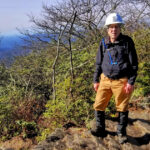
Stewart Holt
November 2024
As a child, long-time Georgia Appalachian Trail Club (GATC) volunteer Stewart Holt noticed something interesting when his parents would take him on trips to Skyline Drive and the Blue Ridge Parkway.
“I asked my dad about all the trails that had the same name – Appalachian Trail,” he remembered. “I didn’t believe a trail could go from Georgia to Maine.”
As an adult, Stewart continued spending time outdoors, often taking scenic day hikes with his family in Georgia. When his son joined Scouts, another parent cajoled him to try backpacking by telling him, “If these little boys can carry all this stuff, you can, too.” Stewart admitted that it was hard at first, but he and his son continued to go on longer trips and hiked over a quarter of the A.T. before his son moved away.
Like many hikers, Stewart hadn’t considered the intentional work and ongoing maintenance needed to make trails both sustainable and enjoyable to hike. “I discovered at some point that the rocks that are conveniently placed on the trail to walk on aren’t there naturally,” he recalled. “They’re put there.”
Stewart joined the Appalachian Trail Conservancy in 1997 and started volunteering on the Trail with GATC. On one of his first work trips, Stewart was inspired by a volunteer who maintained a long section of the A.T. in Georgia for 24 years. Now, after being awarded the GATC Friend of the Trail Award and being recognized for 25 years of service, Stewart undoubtedly motivates others with his own dedication, accomplishments, and longevity with the club.
Though Stewart’s current title is GATC’s Mapping Chairman, he’s used his background in electrical engineering to take on an impressive variety of Trail projects, both in Georgia and beyond. After Hurricane Irma left over 700 downed trees on GATC’s section of Trail, Stewart developed an email-based blowdown reporting system which uses the location data in pictures to report the exact location to sawyers of trees blocking the Trail.
Additionally, Stewart’s expertise in GIS and mapping allowed him to utilize the club’s high accuracy GPS to share up-to-date information with hikers when changes and relocations occur on the A.T. Stewart also helps hikers stay on route with a 10' by 12' wall map he created for the Amicalola Falls State Park Visitor Center and he shares his expertise by teaching classes on GPS systems and mapping.
Stewart has also contributed to the Trail beyond Georgia by working with ATC Director of Visitor Use Management Morgan Sommerville to install both solar and traditionally powered informational kiosks at Abol Bridge and Monson Visitor Center in Maine. He was also instrumental in installing another much-used kiosk at Springer Mountain.
Even with all these projects, Stewart still finds time to help maintain GATC’s section of the A.T.
“I go on a lot of maintenance trips,” he said. “We recently started a rock crew. I’m not the one dragging the heaviest rocks but it’s still really rewarding. We had built such small rock steps on the Trail in the past and that was causing people to walk around them. So now with the proper training and tools we’re doing it right.”
When Stewart reflected on what inspires him to contribute so much of his time and energy to the A.T., he said that spending time with others on the Trail is just a lot of fun. “You’re around people who like the outdoors and hiking,” he shared. “I’ve gone backpacking and day hiking with some of them.”
Just like Stewart has been forward-thinking in bringing technological advances to the Trail, he also thinks about how he can help maintain the Trail experience for future generations.
“I’m picking up and caring for the Trail for the next person, not the person who left the mess,” he said.
Even though his first volunteer work trip was over 25 years ago, Stewart understands that it can be hard for new volunteers to go out on the Trail with people they’ve never met before. But he encourages anyone interested in caring for the A.T. to give it a try.
“The folks showing up are so nice and inviting,” he said. He reminds potential volunteers that they don’t need experience to help. “They’ll show you how to do things.”
Stewart also wants potential volunteers to understand that trail work isn’t a thankless task. “It’s really nice to get all the ‘thank yous’ from hikers. We’re getting more of that. I think there’s more awareness now for volunteerism.”