5 Tips to Help You Stay Safe on the Appalachian Trail
Nov 5, 2026

Nov 5, 2026

When people contact the Appalachian Trail Conservancy (ATC) to ask if the Appalachian Trail is safe, they’re almost always asking about instances of crime or violence. However, environmental hazards like severe weather and tick-borne illnesses are the dangers far more likely to be faced by hikers.
Data helps us understand these risks a bit better, especially as it relates to interpersonal conflicts and crime on the Trail. By the numbers, the Appalachian Trail (A.T.) is quite safe when it comes to crime. Serious incidents remain rare on the A.T., especially given that the Trail saw 16.9 million visits in 2025.
However, two things can be true at once: the A.T. is statistically quite safe, and it is still critical for hikers to be prepared for whatever (and whoever) they may encounter.
If there’s any kind of emergency on the A.T., call 911. This includes if your personal safety is threatened, and/or you need an immediate medical or law enforcement response. If you are supporting a hiker who is having an emergency, call 911 and explain what’s happening to the dispatcher with the hiker’s location.

Be prepared to call 911 by knowing where you are on the A.T. This means knowing where you are in relation to prominent waypoints, towns, and roads—not just what mile you’re at. 911 dispatchers aren’t necessarily familiar with the A.T.
If you’re not sure what town is closest or what county you’re in, sharing any other relevant details can be helpful, especially what road crossings are closest to you since those provide access points for first responders. Other helpful details include if you’re close to any popular viewpoints or peaks, major rivers, etc. Be as precise as possible.
Situational awareness means knowing where you are and what you’re doing, and who’s around you and what they’re doing. It is one of your best defenses against dangerous situations. For long-distance hikers, this includes generally knowing what other hikers are behind and in front of you.
This also means keeping your gear with you at all times, even during quick trips to a view or to use a privy. Know where your essentials are in your pack and keep them handy (headlamp, extra layer, wallet, medications, GPS device if you carry one, and phone).
Personal Safety on the A.T.
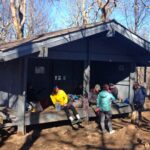
Hikers on Blue Mountain, by Elizabeth Saetta
Also known as intuition, this means that if something doesn’t feel right or you get a bad feeling from someone, listen to that feeling and leave the situation as quickly as you can.
Avoid or get away quickly from people who act suspiciously, seem hostile or unstable, or are intoxicated. This may mean having to hike past where you had planned to camp or take a break, so always be prepared to do this by having extra snacks and water handy, and a headlamp with extra batteries.

Be polite but cautious with strangers and don’t tell them your plans. If a stranger asks you where you’re heading, where you’re camping, etc., keep your answers vague: “I’m heading as far as I can,” or “I haven’t decided where I’m camping tonight.”
If you’re hiking alone, don’t disclose that either. You can respond vaguely by saying things like “Oh, there’s some folks coming up behind me,” or “I’m actually meeting someone later.”

Even if you’re not the target of unwanted behavior, you can still help make the Trail safer by being an active bystander. This is someone who intervenes or interrupts when they witness a concerning situation, and/or offers support after the fact. An active bystander who intervenes tactfully, shows solidarity with a person who is the target of unwanted behavior, or even just checks in with them afterwards can make all the difference.
If you’re in a position to do so, make it clear that harassment and similar behavior is not tolerated on the A.T. Call out bad behavior when you see it, watch out for your fellow hikers, and always aim to de-escalate tense situations.
For more info on how to be a good active bystander, visit Right to Be and RAINN’s resources.
Much of the Trail is deep in the backcountry, and help may be far away. Do not intervene in a situation that will put you or someone else in danger. If a situation escalates and you feel someone’s safety is at risk, move to a safe location and call 911.
If something does happen on the A.T., let Trail managers know! The ATC maintains an Incident Report form for the public to help document and track issues along the Trail across multiple jurisdictions and land management areas. Reports are shared directly with National Park Service law enforcement rangers.
Remember that telling other hikers, posting about an incident on social media, or commenting in FarOut is not reporting it to the authorities that can help; Trail managers cannot continually check all these places and rely on our incident report process to get information.
Important note: Submitting an Incident Report does not trigger an immediate law enforcement or medical response. In an emergency on the A.T., call 911. Submit a report about the incident after the fact once it’s safe to do so.
Horizonline Pictures
When in doubt, submit a report. Even if you feel the incident might have been a one-time situation, law enforcement might have had other reports that they can connect to yours. This could help identify and address a pattern of harassing, threatening, or other concerning behavior. An Incident Report can provide more context about a situation, potential witnesses, and other details that could help with an investigation.