Conservation Corps and A.T. Clubs

Aug 7, 2025

Aug 7, 2025
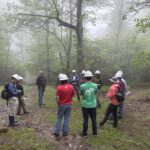

To support the Blue Mountain Eagle Climbing Club (BMECC), the Appalachian Trail Conservancy (ATC) recently hosted a field training led by Josh Kloehn and Rachel Lettre of the ATC. The training helped prepare Club members to collaborate with the incoming Pennsylvania Outdoor Corps crew, a program run by the Pennsylvania DCNR in partnership with the Student Conservation Association.
The training, sponsored by Athletic Brewing’s Two for the Trails Grant, focused on Trail assessment, rehabilitation planning, and collaboration strategies. Participants reviewed how to identify and address Trail issues like erosion, standing water, and tread widening using various solutions like steppingstones, drainage, and trail stabilization techniques. BMECC volunteers also had the opportunity to experiment with different approaches on a section of Trail that faced tread widening due to persistent wet conditions.
In addition to technical guidance, the training emphasized how Clubs can help Conservation Corps crews feel welcomed and supported during joint work projects. “The idea was to help club members think about how they can contribute to a positive experience for the crew,” Kloehn said. “That might mean joining the tailgate safety session, helping with logistics, or just being present and sharing their own trail experience.”
This collaborative approach not only improves the work being done on the Trail but also strengthens relationships across organizations. “It’s not about getting everything perfect the first time,” Kloehn noted. “It’s about creating a space where people can learn from each other and problem-solve together.”
Conservation Corps partnerships offer long-term benefits for Clubs and Trail communities. With many Clubs seeking new ways to engage younger volunteers, these programs provide exposure to trail work and stewardship for individuals who may not otherwise get involved. “Some Corps members may walk away from their season with an interest in joining a club or pursuing a career in public lands,” Kloehn said. “Others just leave with a better understanding of the work that goes into maintaining the A.T., either way, it’s a win.”
For Kloehn, who completed several years of AmeriCorps service himself, the work is personal. “These partnerships open new paths, not just for getting trail work done, but for people to find a place in public land stewardship. You never know what connection will lead to a future volunteer, a new friend, or even a future staff member. That’s what keeps me excited about doing this work.”
By investing in relationships and training opportunities like this one, ATC and its partners continue to build a foundation for long-term stewardship and shared responsibility on the Appalachian Trail.