Why Are the White Mountains So Much Harder To Hike?

Oct 15, 2026

Oct 15, 2026
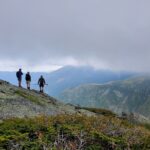
This story is part of our series inspired by the NPR segment “But Why?”, where we answer your most common questions about how the Appalachian Trail (A.T.) is managed.
New Hampshire’s White Mountains, a rugged and wild stretch of over 100 miles of the A.T., are a longtime topic of discussion among visitors to the area. The incredible steepness of the terrain, exposure above treeline, and rock-and-root-filled footpath prompt many to wonder at the section’s difficulty. I spoke with Appalachian Trail Conservancy (ATC) and Appalachian Mountain Club (AMC) staff to answer the common question:
According to Hawk Metheny, the ATC’s Vice President of Trail Management, there are two significant factors that contribute to the difficulty of the White Mountain terrain: the history and geology of the area.
Metheny elaborated on the White Mountains’ rich history of recreation, explaining that when Bostonians began to explore the area for leisure in the 1800’s, they often traveled by way of train to an area known today as Crawford Notch. Once in the notch, visitors of the time took notice of the surrounding mountains and, desiring to take the most direct route to the summit, derived a path that would take them in a straight line to their destination.
“Initially, the routes were what we call ‘fall line,’” Metheny explained. “Right from Point A to Point B in the shortest possible distance.”
This method of hiking—involving straight, steep trails that scaled the mountainsides— worked well for a time when the area did not see high volumes of visitors and therefore experienced less impact to the surrounding environment.
Ilana Goll
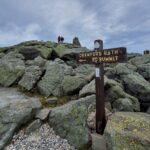
In the 1920s, when the A.T. officially began to be stitched together through the region, it was blazed to follow those trails. “Most of the Appalachian Trail in the White Mountains is on the fall-line trails that already existed,” said Metheny. “And the problem with those is that water also prefers the shortest distance between two points.”
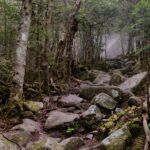
Thus, the A.T. through the White Mountains is subject to higher levels of erosion than many other sections due to water travelling down the fall line and the Trail. Soil is washed away as it flows and reveals rocks and roots that result in rough terrain for hikers to navigate.
The last period of glaciation in New England, about 15,000-18,000 years ago, also contributed to the unique geologic formation of the White Mountains. The section of the A.T. that spans across northern New Jersey and northward is considered to be “recently glaciated,” unlike the Trail that spans across the southern states. The exposed ledge that visitors notice and rocky trails can be attributed to the time of the glaciers.
“When glaciers come through, they scour the landscape and a lot of soil and rock gets removed,” Metheny explained. “That contributed to the steepness of climbing in and out of the notches in the White Mountains, and those classic U-shaped valleys. Plus, it takes a long time for soil to build—thousands of years. There’s very thin soil in the White Mountains, which means when it erodes, it’s gone, and then you’re down to bedrock.”

Laurie Potteiger
The White Mountain region presents a comprehensive list of superlatives: it includes the least amount of soil along the A.T., some of the oldest treadway, high visitation, remote and difficult access for Trail maintainers, and some of the highest amount of precipitation recorded along the Trail.
“If you’re a trail manager, any one of those is a challenge. In the White Mountains, you have all of them,” Metheny quipped. “Because of that, there’s a lot of investment in that section of Trail.”
Matt Stevens, the Central Vermont and New Hampshire Regional Manager with the ATC, acknowledged the difficulty of maintaining such a rugged and unique section of treadway. In the work of conservation, there are extensive regulations involving a review of protective acts before a project can begin.
Janene Sullivan
“[The region is] within the White Mountain National Forest, so we have to work with all of the National Environment Policy Act regulations to make sure that we’re not going to be impacting anything that is federally protected,” he explained. “We do that for every project. It can take at least a year or sometimes more depending on the scope of the project.”
Fortunately, members of the Cooperative Management System are well suited for both rough terrain on the Trail and federal compliance solutions in meeting rooms. Joe Roman, the Backcountry Resource Manager at AMC, spoke highly of the collaborative relationship between the ATC and the AMC when it comes to the role of conservation. “We either debrief how our season went in the fall or how our season’s about to go,” he explained, adding, “Seeing these folks in action has been inspiring as well.”
Stevens also provided insight into how staff at the ATC, AMC, and White Mountain National Forest plan to combat the weather events that impact the White Mountain region with increasing frequency as the planet’s temperature warms. A path that incorporates more switchbacks into its design, instead of following the fall line, is expected to be able to withstand high rain events more efficiently.
“We’re not going to wholesale change the Trail,” he clarified. “But, as it needs to be repaired, I think redesign will be a key component.”
And repairs are coming. Thanks to advocacy by the ATC and partners in the region, the New England section of the A.T. will receive millions of dollars over the next few years to repair deficiencies on federal land through the Legacy Restoration Fund. This includes the A.T. in the White Mountains on White Mountain National Forest land.
Due to the area’s popularity, programs such as the AMC Thru-Hiker Pass have been implemented, which provides discounts for long-distance hikers at AMC campsites and shelters. Roman shared that the pass became “pretty successful right off the bat.” He further explained that the pass works by allowing A.T. hikers to pay a discounted price for campsites, encouraging them to stay at designated sites and lessen impacts from the region’s high use.
“You’re paying the first night, what everybody pays [which is $15], and then after that, it’s just $10 [per night], so a 33% discount,” he explained.

Jordan Bowman
Despite its inherent adversity, the White Mountains also remains one of the most visited sections of the A.T.
“It’s an amazing section of trail. The reward comes at the end of the steep climb when you get on the summit on a beautiful day and you can see 100 miles in all directions,” said Metheny. “There’s really nowhere else where you continuously have that experience on the A.T. except in the White Mountains.”
The famous White Mountains continue to simultaneously test and astound A.T. hikers as they scale ledges and take in the panoramic views that await them–while watching their footing carefully. Hikers can learn more about how to prepare for the terrain and severe weather in the White Mountains by visiting our Hiker Resource Library. Hikers are also encouraged to purchase a Hike Safe Card before hitting the Trail in New Hampshire.

Steven Disser
Explore the A.T. in New Hampshire
Hawk Metheny has been involved in trail management for more than 35 years and started his career in the White Mountains with the AMC as the Club’s backcountry management specialist. He served on ATC’s Board of Directors before joining the ATC as staff in 2010. Hawk thru-hiked the A.T. in 1993, and has also thru-hiked the Pacific Crest Trail and John Muir Trails, along with hiking and section hiking other trails all over the world.
Matt Stevens just celebrated his 25th anniversary with the ATC, and has been involved in managing the A.T. through White Mountains since starting as Regional Manager. He has hiked extensively in New England and elsewhere around the world, and lives in the foothills of the Whites in New Hampshire.
Joe Roman is both the Campsite Program and Conservation Manager for the Appalachian Mountain Club, the A.T. Club that maintains the Trail’s roughest terrain from Kinsman Notch in New Hampshire to Grafton Notch, Maine (except for a ~2 mile stretch around Mt Adams, which is maintained by the Randolph Mountain Club). Joe has been part of the AMC’s field programs for over 10 years and is the AMC’s representative to the New England A.T. Regional Partnership Committee.