Unexpected Finds Along the A.T.

Jan 15, 2026

Jan 15, 2026
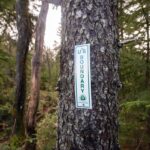
Navigating the A.T. boundary involves expert backcountry skills. It can be extremely dangerous without knowledge of how to use a map and compass and navigate technical terrain. If you are interested in learning more about how you can get involved in maintaining the backcountry, find a volunteer opportunity here.
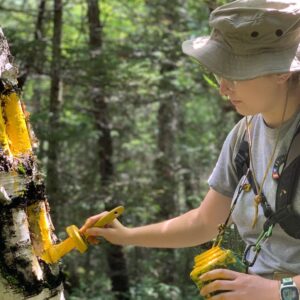 There’s a term called “yellow blazing” used amongst long-distance hikers. It tends to have a negative connotation, that of skipping parts of a trail by getting rides along the road (the “yellow blaze” being the road’s centerline). However, did you know that the Appalachian Trail actually has far more actual yellow blazes than white blazes? Yellow blazes mark the boundaries of the Appalachian Trail corridor, narrow strips of land totaling approximately a quarter-million acres along the Trail. These boundary lines are monitored and maintained by volunteers and staff to protect the Trail from exterior threats such as logging and dumping.
I am one of those boundary maintaining members of the ATC’s staff. Following my 2013 thru-hike, I began working seasonally in 2016 and have remained involved in this program ever since. I am also a Maine Appalachian Trail Club volunteer, monitoring the corridor around Gulf Hagas. I’ve spent about 600 days over the past ten years on the boundary lines from Virginia to Maine.
Boundary maintainers like me are trained to leave the traveled path and follow yellow blazes in straight lines – or try to do so in rugged terrain. When we do our work, we see some interesting things that hikers on the Trail don’t often see. Here are a few examples from my time maintaining the A.T. corridor lands. I’ve only included partial location information with these highlights to protect Trail visitors and the landscape. The best way to experience the A.T. corridor beyond the Trail is to join a boundary maintenance volunteer opportunity.
There are some parts of the A.T. corridor which the Trail does not cross. Sometimes the A.T. is moved significantly in a relocation, while other times a better route is identified before any iteration of the A.T. is laid through it. One such parcel in Maine had a pond to circumnavigate, from which there were good views of the Bigelow Range.
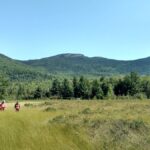
Waterways are commonly used as boundary lines. In one case in Virginia, the boundary line gains almost 1,000 feet of elevation while following a cascading stream. There wasn’t much water flowing on the November day when I last worked there, but the view was rewarding after scrambling up out of the hollow.
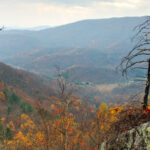
Who left Larry at a survey monument in Vermont? Past volunteers and staff have occasionally left surprises like this for future boundary monitors. Sometimes they even accidentally leave surprises for themselves, such as one volunteer who accidentally dropped a water bottle and found it two years later.

Traveling in straight lines in the woods isn’t only a challenge in Maine. While the A.T. through New York doesn’t ascend to great elevations, it does traverse steep slopes. I’ll never forget the first time I encountered a stepladder placed on the A.T. Blazing a straight line across these slopes has some exciting moments.
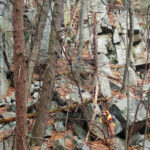
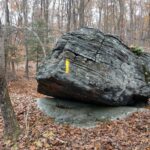
Many of the surveyors have opted against painting blazes on rocks on the boundary line. Some of the surveyors in New York were rather keen on rock blazes though, such as this one on what’s likely a glacial erratic – a rock picked up and dropped somewhere else by a glacier.
These are a few examples taken from my first few years on the A.T.’s corridor lands. Over the course of my time as a member of the ATC’s staff and as an MATC volunteer, I’ve seen countless interesting things — unique markers, wildlife, lost items, and rugged land.
While hikers and visitors to the A.T. should always stay on marked trails, if you’re curious about what exists along the Trail’s boundary, or you’re interested in helping to protect the Trail’s corridor from external threats, I encourage you to join a boundary monitoring outing with your local Trail Maintaining Club!
Garrett Fondoules is the Maine Land Stewardship Coordinator at ATC.

Your gift for the A.T. will go 2x as far with the 2,000-Miler Match!
A group of 2,000-Milers are matching every gift made to the ATC up to $101,000 before 3/31.
Give Now