Restoring Appalachian Trail Grasslands
Jun 24, 2026

Jun 24, 2026
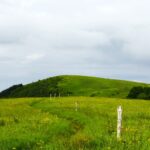
Breezy, buzzing grasslands are some of the most beloved destinations on the Appalachian Trail. Where hikers flock for scenic views, wildlife shelters in crucial habitat.
Grasslands along the Appalachian Trail require careful management to keep lively and beautiful, although it looks a bit different from typical lawncare at home.
This June for National Grasslands Week, frolic with us as we spotlight the importance of the green, green grasslands of home, and share some of the work underway to revitalize meadows along the Appalachian Trail.
Photo: Matt Drury, ATC, surveys Max Patch for Golden-winged warbler. Birds and other animals use grasslands along the Appalachian Trail for habitat.
Let’s stroll up Max Patch, bordering North Carolina and Tennessee. This easily accessible, scenic grassy bald is so well beloved that it became degraded over a span of years by frequent and heavy visitation.
Crowds trampled vegetation and campers left behind trash, depreciating the former agricultural land’s ecological and scenic value.
Previously, the old connector leading up to the Appalachian Trail at Max Patch was an eroding eyesore wearing a gash in the mountainside, says Matt Drury, Associate Director of Science and Stewardship for Appalachian Trail Conservancy.
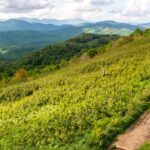
Horizonline Pictures
“It’s like night and day the way that the bald has responded and recovered,” Drury said. “Ecologically, it’s beautiful and much more functional than it was, and it’s a much more natural hiker experience.”
The ATC and partners planted more than 10,000 plant plugs and sowed hundreds of pounds of native seeds on Max Patch since rewilding work started in 2017. Carolina Mountain Club and the USDA Forest Service are active and essential partners with the ATC in Max Patch’s recovery, and the work continues.
“We’re not ‘whacking’ trees just to maintain viewsheds. We’re trying to provide habitat for a myriad of species,” Drury said. “We’re looking to provide for the hiker experience with long-range views, to get a break from the Green Tunnel, but we do it with ecology in mind.”
The aim is to intentionally keep Max Patch and other grasslands as early successional habitat, whereas without maintenance it would gradually mature back into dense forest. Stopping the ever-encroaching woods and thorny blackberry bushes along the grassland’s edge maintains views and encourages diverse wildlife habitat.
Photo: A tiger swallowtail butterfly pollinates wildflowers at Max Patch along the Appalachian Trail in North Carolina.
A forest service closure order prevented camping on Max Patch, enabling the land to recover. That closure order was recently extended another three years, into summer 2029.
“To maintain and restore the bald, we use a variety of tools like mulchers and chainsaws,” Drury said. “We also have a mowing regime up there to keep it at an early successional state.”
Max Patch is one of many such grasslands along the 14-state A.T. corridor. These are places where, when managed correctly, native species like birds and pollinators thrive, and the A.T. experience remains wild.
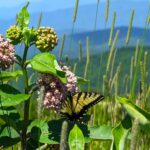
Photo: Appalachian Trail grasslands wave on a blustery day atop Cole Mountain in Virginia.
Grasslands are an Appalachian Trail feature in every state but Maine, says Marian Orlousky, ATC’s Director of Science and Stewardship.
From Georgia to New Hampshire, the Appalachian Trail Conservancy works with agency partners and volunteers to manage about 185 different grassland sites. These vary in size from small patches to a few hundred acres.
“Appalachian Trail grasslands include many of the high elevation ridgetop balds in the south, and the bucolic lowland meadows of the northern regions,” Orlousky said. “The ATC works with partners to maintain around 1,000 acres of early successional habitat annually, which largely constitutes grasslands, but also includes some other early successional habitat types.”
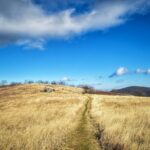
Gina Knox
Like Max Patch, many grassland areas near the Appalachian Trail were formerly used for agriculture. These spots are good candidates for grassland restoration and rehabilitation work, enabling the land to support more native biodiversity like birds and pollinators.
Still today, local farmers maintain hundreds of other plots along the A.T. as hay or crop fields under permitted agreements. These aren’t functional grasslands, but they do provide important open habitat, offer special views, and provide historic land use context for A.T. hikers.
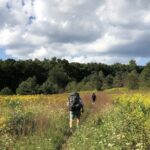
Photo: Backpackers traverse a blooming meadowland section of Appalachian Trail in Pennsylvania.
Grassland-dwelling animal species are under threat from habitat loss and degradation. Research indicates that among bird groups in various habitats, grassland birds have experienced the greatest declines across North America during the past 50 years.
“Grass-nesting and ground-nesting bird species — like Eastern meadowlark and bobolink — depend on large open acreage for breeding, forage, and nesting,” Orlousky said. “There are also bird species that don’t use grasslands exclusively but do utilize them for some purposes or specific portions of their lifecycle.”
Meredith Snyder
Around thriving grasslands, a birder might spot Eastern bluebird, loggerhead shrike, ruffed grouse, golden winged-warbler, and many different hawks, owls, and other birds of prey. Meadows are also ideal spots to spy spring, summer, and autumn wildflowers.
“Diverse grasslands contain a variety of native flowers, sedges, grasses, and rushes, some of which have become rare due to a loss of habitat,” Orlousky said. “Many species of native insects flourish in these areas — bees, moths, butterflies, beetles, and more — using them for nectar forage, pollen, and habitat.”
This summer, ATC began work with the NPS on grassland reconstruction at a series of former agriculture sites along the Trail in Pennsylvania and Maryland. It’s part of a multi-year Eastern Grasslands Initiative funded and led by the National Park Service, covering more than 30 park units across the eastern United States.
When you support the Appalachian Trail Conservancy by learning more about A.T. management, donating, or becoming a member, you support long-term efforts like these to keep the Trail and its surrounding landscape alive, both for hikers and the native plants and animals that call the Trail corridor home.
Additionally, these efforts aren’t exclusive to large-scale grasslands — native species can grow in the comfort of your own backyard, creating habitat for pollinators and birds. Whether you’re caring for native species by planting native wildflowers in your yard, or practicing Leave No Trace on the Trail, your actions are part of a larger effort to protect the planet we all share.