Protecting Pollinators

Jun 27, 2020

Jun 27, 2020

For two weeks last summer, I honed a skill that I had not practiced in many years. I slowly and deliberately stalked through patchy groves of cedar and chestnut oak, keeping my eyes peeled for any sudden movements. Sweating in the midday sun, I inspected each flower: Black-eyed Susan, New Jersey tea and woodland sunflower. When I spotted telltale signs of brown and orange, I sprang to action. I felt at once like a focused hunter and an overgrown child.
Fully armed with a big round net flowing in the wind, I was catching Northern metalmark butterflies (Calephelis borealis) as part of an ongoing research project near the Appalachian Trail (A.T.) in western Connecticut. This is the northernmost population in the species range and the only population in Connecticut, as the species is state endangered and globally declining. The Appalachian Trail Conservancy (ATC) partners with researchers at the University of Connecticut, local Appalachian Mountain Club volunteers, ecological restoration contractors and an electric utility company to monitor and conserve this species.
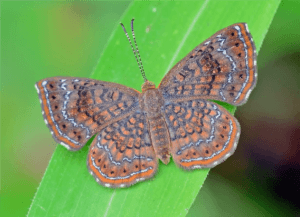
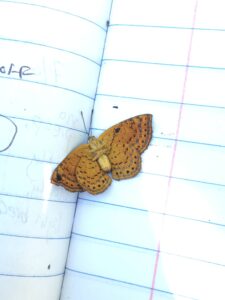
My butterfly catching was part of a specific mark-recapture monitoring protocol. Each caught butterfly was temporarily put to sleep in a jar (though we don’t leave it in there too long!) and marked with black dots on the bright orange underside of the wings. The position of the dots signified numbers, and butterflies were marked sequentially in the order they were caught. Additionally, I recorded the sex, specific location and any other notes regarding the caught butterfly, before letting it go. When I caught a butterfly that had been marked before, I still took down its number and sex before setting it free. If a Metalmark escaped my net, I’d make note that I saw it as this data would allow researchers to estimate the size of the Metalmark population and understand their life cycle. With data taken every year, we can track long term population trends.
Here are some of the precautions we take to minimize harm to butterflies:
Northern metalmark butterflies have specific habitat needs and we are working to manage the land to suit these needs. They require cedar glades with areas of open and dappled sunlight, so we selectively removed some trees to open up the canopy. We plant wildflowers such as New Jersey tea (Ceanothus americanus) and woodland sunflower (Helianthus divaricatus) for the butterflies to nectar on. Finally, like many sites, we removed invasive plants that crowd out beneficial native plants.
This project is just one of many along the A.T. that benefit pollinator species.
So, what is a pollinator?
A pollinator is an animal that moves pollen from the male part of a flower to the female part of a flower, within one flower or from one flower to another. This action facilitates fertilization, seed and fruit production, and thus plant reproduction. Pollinators include butterflies, moths, bees, beetles, birds, bats and other animals.
Without pollinators, most plants cannot make seeds or fruits, and therefore cannot reproduce. Many of the foods we eat rely on pollinators, including honey, apples, peaches, blueberries, squash, melons, pumpkins, potatoes, vanilla, almonds, chocolate, coffee and, of course, tequila. Worldwide, pollinators are declining due to habitat loss, pesticide misuse, diseases, parasites and invasive species. In the United States, over half of the managed honeybee colonies have been lost in the past ten years. Multiple factors contribute to the death and decline of pollinator species.
Human impacts cause habitat loss, fragmentation and degradation that contribute to the decline of pollinator species. Developed areas and lawns with grass mowed short cannot support pollinators. However, not all disturbances caused by a physical disruption to the ecosystem harm pollinators, since many species need open, early-successional habitats like old fields, pastures, and grasslands. These early-successional habitats provide areas for foraging and nesting sites for pollinators. Managing for pollinator species habitat has beneficial implications for forested landscapes and adjacent agricultural systems, such as increased crop yields too.
Along the A.T., forests have grown up in areas that were once open pastures, orchards or agricultural fields. The ATC works together with land managers throughout the A.T. ecosystem to establish and maintain existing open areas with the goals of providing views for hikers, preserving agricultural character, suppressing invasive species and providing meadow environments for pollinators and other wildlife. Some fields are still hayed by local farmers who have Special Use Permits with the National Park Service, while others are mowed by land managers. Some sites are also planted with wildflowers that benefit pollinators.
The A.T. offers some very promising sites to see pollinator species at work. We encourage visitors to stay on the Trail when they visit these sites to avoid trampling the habitat that the pollinators need. In the Southeast, some highlights include Siler Bald in Nantahala National Forest, Max Patch, the open area just south of Street Gap, Big Bald, Beauty Spot and the Roan Massif. New England offers many hilltop open areas, boasting two dozen fields between Killington and Norwich, Vermont, including Dupuis Hill, Arms Hill, Upper Lewis Field and Merrill Hill. There are also many open areas in New Hampshire, Massachusetts and Connecticut that offer great views and prime pollinator habitat.
How can you play a role in protecting pollinators?
Look for a volunteer opportunity near you by visiting http://www.appalachiantrail.org/volunteer.