How the Government Shutdown is Impacting the Appalachian Trail
Nov 3, 2025

Nov 3, 2025
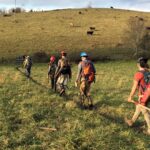
With the government shutdown in its fifth week, rivaling the longest government shutdown in U.S. history, crucial work along the Appalachian Trail (A.T.) has been halted. Impacts to the Trail are wide and varied, even though hikers and campers may not notice them just yet. Because of the way the A.T. is managed and funded, disruptions in 2025 can have cascading effects in later years.
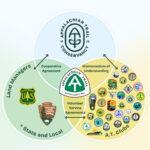
The Appalachian National Scenic Trail is among the most complex conserved areas in the nation, relying on volunteer, state, federal, and private entities to ensure its ongoing maintenance and care. Volunteers are the soul of the A.T. and its primary workforce, but without federal, state, and the Appalachian Trail Conservancy’s (ATC) support, the Trail would not exist.
The legal framework governing the A.T. gives shared responsibility to the National Park Service (NPS), USDA Forest Service (USFS), the ATC, and 30 A.T. Clubs. This arrangement requires substantial involvement with our federal partners, the NPS and USFS, to complete maintenance, construction, and relocation projects, which are proposed by the ATC and A.T. Clubs. If our federal partners are unable to participate in project identification, refinement, and to submit projects for funding support to the NPS, necessary work will be delayed if not cancelled completely, and the Trail experience will suffer as a result.
Multiple natural resource management projects throughout the Mid-Atlantic and New England regions are on hold because our government partners are furloughed and cannot complete necessary compliance work. This means that crews are unable to proceed with specialized contracted work, such as the removal of invasive plants that degrade the Trail. This will delay these projects, which become more complicated because of the delays, for at least a year.
The environmental assessment for a multi-year, multimillion dollar bridge construction at the Wallkill River National Wildlife Refuge is on hold until the government reopens, complicating the timeline to move the A.T. off a public road, and threatening to add more costs to the project.
Ben Earp
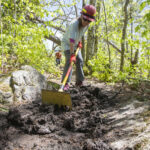
Volunteers on sections of the Trail, including on the Blue Ridge Parkway and in the Chattahoochee-Oconee National Forest, are unable to steward the A.T. because of furloughed or lost agency staff positions at those units. Without required engagement of federal partners, connected national parks and forests can withdraw permission for volunteers to work on the A.T.’s treadway and corridor. This means that these popular trail sections, which are still recovering from Hurricane Helene, are falling behind on maintenance, jeopardizing the Trail experience and hiker safety. Additionally, without on-going ability to steward the A.T., the Trail is at risk of losing committed volunteers.
The $15 million Legacy Restoration Fund tread restoration project spanning Connecticut through Maine has also been further delayed by the unavailability of NPS and USFS staff. In the A.T.’s modern history, this project is second in scope, collaboration, and partnership investment only to the ongoing Helene restoration work. It has already been delayed by Congress not adopting a fiscal year 2025 budget (October 2024-September 2025).

Katy Perry Photography
Delays or disruptions may be common in project work because of unforeseen or unavoidable circumstances, but delays and disruptions caused by government dysfunction are avoidable.
It is important for A.T. supporters to advocate for Congress and the President to come together to fund the government. This dysfunction is bad for our democracy and also bad for the Trail. The A.T. and the incredible people and places it connects deserve better.