Federal Agency Restructuring is Impacting the Appalachian Trail’s Future

Apr 17, 2025

Apr 17, 2025
The Appalachian Trail exists today because of passionate individuals, the ATC and the A.T. Clubs who envisioned and built a continuous footpath through the Appalachian Mountains AND agency personnel who have collaborated with them to ensure public access. A.T. stewardship and improvements require ongoing collaboration and support between its cooperative managers and supporters.
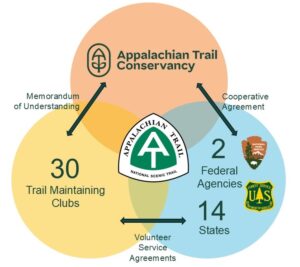
To ensure the A.T. treadway, corridor, and landscape are maintained and conserved, the ATC operates within the Cooperative Management System (CMS). The A.T.’s CMS is often described as a “three-legged stool” because it relies on the balancing and sharing of responsibilities by the land managers (the National Park Service, USDA Forest Service and state agencies), the Appalachian Trail Conservancy, and the local trail-maintaining Clubs.
Each partner from the “trail administrator” National Park Service (NPS) to volunteer crew members play critical roles in the Trail’s success. The ATC is the unifying entity between the government agencies that manage the federal and state public lands and resources and the A.T. Clubs and their volunteers that provide local stewardship and on-the-ground knowledge of every section of the Trail.
The CMS spreads responsibilities out over many partners with a dedicated 10-person NPS office focusing exclusively on the Trail. These dedicated and skilled public servants have an enormous workload, funneling the volunteer-generated projects of the A.T. Clubs through an oversight process necessary to ensure protection and effective stewardship. At the differently structured USDA Forest Service (USFS), responsibility for the A.T. is spread across many more civil servants, who have a variety of other trust resources to manage in addition to the Trail.
All maintenance and operational work on the Appalachian Trail requires supervision and approval from the USFS where it runs through national forests and the NPS when it’s done on National Park System lands. This includes ensuring National Environmental Policy Act compliance and having agency archaeologists and biologists assess any trail relocation projects before they can begin, including work to build more resilient footpath and Trail features in sections damaged by Hurricane Helene and in parts of the Trail where erosion and flooding are more frequent.
Beginning on January 27, 2025, the Trump Administration initiated a wave of federal workforce and partnership actions, including freezing all federal assistance and terminating over 3,000 probationary employees at the USFS and nearly 1,000 at the NPS. These mass firings, led by the White House’s “Department of Government Efficiency” (DOGE), were part of broader Executive actions aimed at shrinking government and its expenditures. Federal courts ordered the funds unfrozen and agencies reinstate the employees, although appellate court decisions in early April have enabled the terminations to continue, sowing additional confusion for our federal partners and in our partnerships.
Concurrently, there has been a push for current federal employees to accept early or deferred retirements ahead of expected Reductions in Force (RIF). A February 26 memo from the White House’s Office of Management and Budget and the independent Office of Personnel Management (OPM) laid out a two-phase approach: Phase 1 required immediate staff and program cuts, and Phase 2 outlined long-term restructuring plans including regional office closures, role consolidations, and further workforce reductions.
As reported this month, approximately 3,500 USFS employees have taken the second buyout offer, and ATC believes many more are leaving the agency ahead of drastically changed priorities and reports of a planned reorganization.
These reductions in staff are very concerning, given the number of acres, visitors, and trust resources the USFS oversees, and the work ahead to repair and restore the Trail through southern national forests after Helene.
The loss of long-serving staff also means a loss of institutional memory—relationships, historical context, and operational know-how that cannot be easily replaced. The impacts of this institutional memory loss will undoubtedly set us and the A.T. back in unexpected ways.
The reported staffing reductions and rapidly shifting federal priorities are already affecting operations across both the USFS and NPS, from trail maintenance to permitting and recreational access. In some cases, positions tied directly to the A.T.’s day-to-day oversight have been left vacant, severing long-standing working relationships and reducing capacity just as spring field season ramps up.
The severe disruption to the agencies impacts every aspect of cooperative management. Trail crews working on the A.T. have been warned to expect reduced federal support in the coming months. This unpredictability and the uncertainty of federal funding makes it difficult to plan maintenance and repair work beyond the current planning period. Some of our partners on other trails have already cancelled or truncated their field seasons, negatively impacting the resource, users, and surrounding communities.
Our public lands are a source of bipartisan pride, but in a democracy, it is difficult for anything to remain apolitical. This is because, at the core, decisions are made through the political process. The Appalachian Trail community has long depended on consistent federal presence to uphold its side of the cooperative management model and accomplish the “inherently governmental and non-delegable” tasks that only the federal government may perform.
Now, with this continued instability in agency staffing, structure and support, the A.T. faces significant risks. We urge the supporters of the A.T. to get involved in the democratic process to inform our federal decision-makers why the A.T. is important to them and that we want to see no reductions in support to the dynamic and collaborative Appalachian National Scenic Trail, a world-renowned and celebrated treasure.
Contact your U.S. Senators, U.S. Representatives and the White House to demand that our beloved public lands and national trails have the federal staffing and resources required to advance critical trail stewardship work.