How the ATC Is Fighting Invasive Species After Hurricane Helene
Feb 26, 2026

Feb 26, 2026
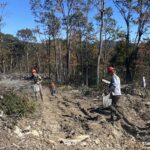
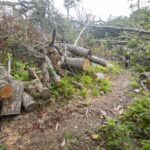
When Hurricane Helene tore through the southern Appalachians, it reshaped everything from local communities to the Appalachian Trail landscape. The A.T. itself was impassable in several sections, buried beneath downed trees and debris. The high winds and rain also had massive ecological impacts as they opened forest canopies, disturbed soil, and created ideal conditions for non-native invasive species to thrive.
Disturbance events like hurricanes are opportunities for non-native invasive species to spread fast and far.
For the Appalachian Trail Conservancy, this was a critical moment to act. Not only to clear the Trail where millions of people come to connect with nature each year, but to stop the spread of non-native invasive species before they make the A.T. landscape unrecognizable.
Even before Helene made landfall, ATC staff were already hard at work for nearly two decades, inventorying and treating non-native invasive species along the Appalachian Trail. In the Southern and Virginia regions, the National Fish and Wildlife Foundation’s (NFWF) America the Beautiful Challenge program was a watershed moment that provided added capacity, supporting a multi-year effort from 2023 to 2025, which included pre-Helene and post-Helene work.
Since the NFWF America the Beautiful Challenge project began in 2023, the ATC has treated 590.1 acres of non-native invasive species, protecting native habitat and biodiversity, exceeding original goals by 268%.
In 2025 alone:
Work stretched across sites in Georgia, North Carolina, Tennessee, and Virginia, including:
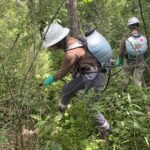
In the greater Erwin, Tennessee area, which was heavily impacted by Helene, more than 25 acres were treated in 2025 against non-native invasive species like the emerald ash borer, garlic mustard, and tree of heaven. At Temple Hill Gap, over 20 acres of tree of heaven were controlled using targeted methods like hack-and-squirt and basal bark application.
Storm damage led to significant tree mortality in parts of Georgia, North Carolina, and Tennessee. But even in those altered landscapes, the ATC continued re-treating ash trees to protect them from the emerald ash borer (Agrilus planipennis). In 2025, 290 ash trees were re-treated across multiple sites out of the nearly 900 ash trees the ATC is protecting in the southern region.
Why does that matter? At places like High Rocks, North Carolina and Moffett Laurel, Tennessee, where canopy loss from Helene was significant, protected ash trees can now seed into disturbed areas. In a forest recovering from storm impact, those living trees become part of the next generation of healthy trees.
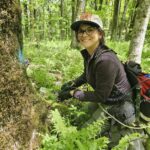
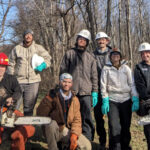
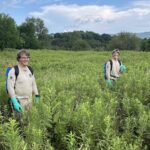
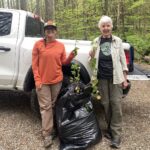
Non-native invasive species management is hands-on work, and A.T. volunteers showed up. Across six sites in Tennessee and North Carolina, 16 volunteers helped remove 686.5 pounds of garlic mustard, an aggressive invasive plant that can outcompete native wildflowers. Over 25,000 pounds have been pulled Trail-wide in the last decade.
Clubs and partners including Tennessee Eastman Hiking and Canoeing Club, Carolina Mountain Club, Smoky Mountain Hiking Club, Roan Mountain State Park, the USDA Forest Service, and Southern Appalachian Highlands Conservancy participated in these efforts.
Youth Corps crews also played a major role. In Virginia, three Appalachian Conservation Corps workweeks treated 69 acres across two priority sites, including areas managed for early successional habitat and a USDA Forest Service priority trout stream at Dry Run in Atkins, Virginia. Controlling non-native invasive species in riparian zones supports water quality and habitat for sensitive species downstream.
Removing invasive plants is only part of the story. Since 2018, over 10,000 wildflowers and grass plugs have been planted at Max Patch since 2018.
For the NFWF America the Beautiful Challenge program, restoration followed removal at several sites:
These efforts help ensure that native species reclaim disturbed ground.
The ATC’s non-native invasive species monitoring program often happens behind the scenes, outside of the awareness of those who walk the Trail. Most A.T. visitors enjoy the sounds of native bird songs and the sites of native trees and flowers without considering the resources that go into protecting these irreplaceable parts of the Trail experience.
Disturbance events like Hurricane Helene are a reminder that the Appalachian Trail exists within a dynamic landscape, especially as climate change fuels stronger and more frequent storms. But by investing in monitoring, balancing long-term management with rapid response, training volunteers, and restoring habitat after disturbance, the ATC not only reacts to changes, but also uses a century of experience to proactively protect the A.T. and its landscape for generations to come. It’s the often-unsung, behind-the-scenes work that keeps the Trail alive.
This 3-year project in the southern Trail states demonstrably led to healthier forests across nearly 600 acres, protected ash trees standing in recovering landscapes, thousands of staff and volunteer hours invested, and a Trail that continues to be a place where people can walk a mile or 2,000 miles and come away transformed.