A.T. Most Unwanted: Invasive Plants

Sep 3, 2026

Sep 3, 2026
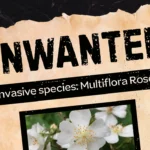
For their high crimes and misdemeanors against Appalachian Trail ecology, it’s time to name and shame some of the most unwanted flora in the entire Wild Wild East.
They creep, climb, and play lowdown, dirty tricks to outcompete native plant life. They’re no-good, rotten nuisances. Oh, and they’re smelly, too.
Pony up, deputy, and let’s get on the Trail to learn something more about invasive plants. After that, we’ll catch up with the rootin’ tootin’ Appalachian Trail Conservancy (ATC) Strike Team to hear what they’ve been tracking across Southern Appalachia after Hurricane Helene.
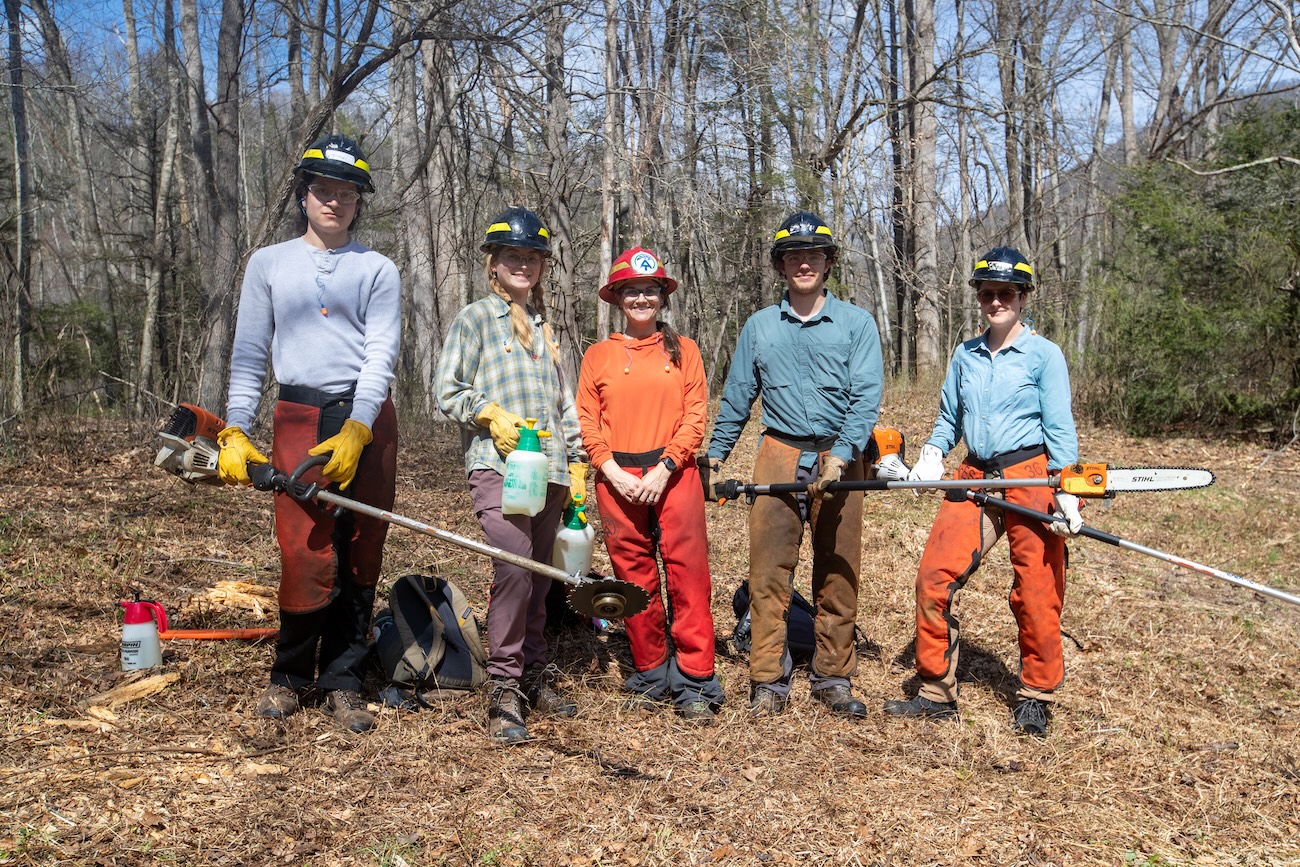
Left to right: Justin Tapia, Evie Davis, Emily Powell, Alex Dullea and Claire Jarvis, members of The Appalachian Trail Conservancy’s Invasive Species Strike Team on The Appalachian Trail near the Dennis Cove Trailhead.
Thwarting the spread of invasive species is a sworn duty for Claire Krotoski. She is the ATC’s Non-Native Invasive Species Coordinator for Virginia.
“Invasive species have the ability to adapt to many environments due to lack of predators,” Krotoski said. “Invasive plants are non-native species that spread quickly by humans and animals, but are not beneficial to animal or environmental health.”
Taking a water break beneath the balmy August sun, Krotoski stands atop a heap of wilted plant matter. It’s been a long morning on the lookout for invasive plants and spraying from the hip to kill them.
Here bordering the A.T. is a grassland habitat maintained by the USDA Forest Service located near Dismal Falls in Bland County, Virginia. Out in the field today with Krotoski is a four-member posse called the ATC Non-Native Invasive Species Strike Team, patrolling for unwanted plants to pluck, saw, spray or otherwise bring to justice.
Stood among a field of felled autumn olive, Strike Team Member Alex Dullea spits on the ground and then stomps it when he says the name of this shimmery silver shrub.
Left unchecked from its bushy beginnings, an autumn olive plant can grow 20 feet tall and 30 feet wide, shading out native grasslands. It plays dirty tricks by impairing surrounding soil chemistry using a witchy process called allelopathy.
“That’s basically what cowboys would call poisoning the waterin’ hole,” Dullea said. “It kills wildflowers.”
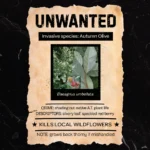
Also known as Japanese knotweed
For Strike Team Member Claire Jarvis, their work is motivated by the same spite shown by invasive plants like knotweed, which grows into thickets that shade out native species.
“It’s the most ecologically terrifying plant. It’s so hard to kill,” Jarvis said. “It spreads everywhere. Once there’s a tiny piece of it anywhere, you’re in trouble.”
The leaves are smooth-edged and typically feature reddish stems, with deep roots that will readily grow back if left intact. It grows in bamboo-like thickets.
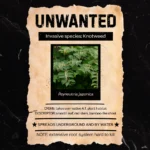
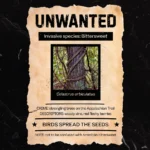
Also known as Oriental bittersweet
Signing like he’s choking, Strike Team Member Justin Tapia says native plants should watch their neck around the woody bittersweet vine.
“The coiling, constricting vine,” Tapia said. “It’s snakelike—like, in the bad way. A real snake in your boot.”
The smothering vine will grow by itself in creeping thickets, or attach to a tree and climb up to 40 feet vertically, smothering the tree in the process. Birds eat the bright red berries and spread the seeds.
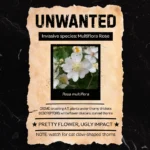
What’s in a name? That which we call a rose by any other name would be a weed.
Strike Team Member Evie Davis can barely keep herself from cursing when she starts to talk about this thorny nuisance.
“A lot of people call it M.F. rose, and that’s for a reason,” Davis said. “It’s the one that fights you back the most.”
Every rose has its thorn. These are slightly curved like a cat claw, making thickets impenetrable, and removal a prickly affair.
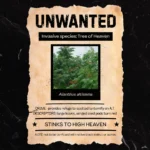
There’s really nothing heavenly about this hellish plant, also known as stink tree. It’s a co-conspirator as the preferred host plant for another invasive species, the icky insect called spotted lanternfly.
“It just sinks my heart when I see it,” Krotoski said. “And it stinks my nose. Then you notice the spotted lanternflies all over it.”
Like autumn olive, tree of heaven is also allelopathic, poisoning the soil to prevent competition from native plants.
These are some of the recurring suspects as ATC’s Non-Native Invasive Species Strike Team travels across hundreds of miles of A.T. that were impacted by Hurricane Helene in September 2024.
In the two years since the storm, an abundance of felled trees opened space on the forest floor, creating opportunities for these adaptable, fast-growing invasive species to rush in before natives could gain a foothold.
We’re not just letting these bandits run amok in the Appalachian wilderness. There are some invasives, like garlic mustard, that you can volunteer to help pull. Other removal efforts require more of a showdown.
For many of these invasive plants on the most unwanted list, merely cutting or pulling the weeds is not enough to stop their spread. In many cases, the work requires chainsaws as well as the careful application of pesticide to ensure the plant dies down to its roots.
Some of these plants were introduced in gardens as ornamentals. For other plants, foresters introduced them on purpose, with intentions to stop erosion and provide wildlife habitat.
Some invasive species are still available for sale at major retailers, putting the burden on home gardeners to know what they’re planting in the backyard. Planting native flora at home helps prevent invasives from spreading onto nearby public lands like the A.T.
“Invasive species are not just a problem you point at,” Krotoski said. “It’s a problem you have to act on.”
Learn More about Science & Stewardship on the A.T.