The Appalachian Trail, Then and Now: Two 2,000-Milers Reflect
Apr 22, 2026

Apr 22, 2026
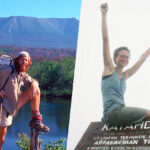
Before they were colleagues at the ATC, Kathryn Herndon-Powell and Morgan Sommerville were hikers standing at the edge of something bigger than themselves. Morgan began his thru-hike in 1977, and Kathryn completed hers in 2006. Both have since devoted their careers to advancing the ATC’s mission. In a recent conversation, they reflected on how the A.T. shaped their lives.
Kathryn Herndon-Powell (KHP): This year marks 20 years since I completed my thru-hike, and lately my daydreams have been filled with moments that still feel as vivid as yesterday.
And Morgan, I know that next year you’ll celebrate an extraordinary milestone, 50 years since you began your hike in 1977!
Take us back in time… Do you still remember what it felt like on that first morning, standing there under the Springer Mountain arch, knowing the journey ahead would change your life?
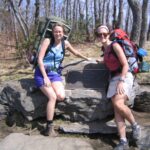
Kathryn sets out from Springer Mountain.
Morgan Sommerville (MS): Well, technically I didn’t start under the Springer Mountain arch; it didn’t exist yet! My hike actually began about three miles south of Springer at Nimblewill Gap, and it was a gloomy day. Before long we were hit with something like nine inches of rain. It got cold enough that my hiking partner, a college friend named Vann Waters, and I started wondering if we might freeze to death out there.
We spent the night at Hawk Mountain Shelter and once we realized we were probably going to survive, we just kept going… with the same resolve we started with.

Morgan rests on Blood Mountain.
KHP: I started my hike with my high school best friend. She was the experienced backpacker. I had only been on one overnight trip before. I quickly learned that the gear I packed needed some upgrading. I remember those early weeks in Georgia and the Smokies. Being cold and wet, and trying to soak up every moment of sunshine whenever it appeared.
But I also remember the emotional transition. At first there was that nervous feeling of being out in the woods for so long. Then slowly that fear gives way to confidence. You start to feel the freedom of moving through the mountains under your own power. And somewhere along the way, we all go a little feral!
Morgan, do you remember when your trail legs kicked in? I got mine about six weeks in, just like everyone says.
MS: I think we got ours a little earlier. At one point we managed to outpace a group of college students we had been leapfrogging with so we could snag the best campsite.
MS: Back then the ATC had published a book on what gear you should carry, but even in the 70s the gear industry was quickly evolving. I ended up mailing a lot of the supplies back home. Heavy wool pants were one of the first things to go. Eventually I even ditched the body of my tent and just carried the rain fly.
Navigation was completely different, too. We used a guidebook and compass, and I actually tore the guidebook apart as we hiked, discarding sections we had already passed.
And communication? There basically wasn’t any.
There were also far more road walks in those days. And let me tell you, they were awful. Thankfully many of those sections have since been replaced by real Trail, like the famous Roller Coaster section in Virginia. I also remember starting in mid-March and barely seeing another hiker until Shenandoah. It’s very different now.
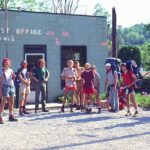
Morgan's tramily stops by the post office.
KHP: It really is.
When I hiked in 2006, we were right on the edge of cell phones becoming widespread. Flip phones existed, but they were heavy enough that many hikers still didn’t carry them. I had a calling card with a limited number of minutes and would hunt down landlines whenever we reached a town so I could call my mom.
And there was certainly no expectation of constant updates! There were no vlogs or social media documenting every mile. Some hikers would post updates on Trail Journals, but even that usually meant finding a public library computer in town.
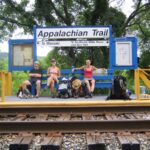
Kathryn and friends head to town.
One thing I think Morgan you would agree with me on is that the shelter logbooks were better back then. People left long entries, drawings, and advice for hikers behind them. There was this incredible sense of camaraderie and storytelling! Today hikers still write in them, but people are often in a hurry.
One funny thing that still happens every year: hikers reach a stretch around the Virginia border where cell service suddenly disappears for a while. For hikers today who have been texting family regularly, that sudden silence can cause a little panic. Every year the ATC receives calls from worried parents who haven’t heard from their hiker for a day or two!
MS: Despite all the differences, some things never change… like the Trail culture! Even back in 1977, a small “tramily” formed. There were about six or eight of us who hiked together for quite a while.
KHP: Very true! Also, one of the things I love seeing today is the growing diversity of hikers.
When I hiked in 2006, only about a quarter of long-distance hikers were women, and my friend Margaret and I often felt like outliers. Now the Trail welcomes people from many more backgrounds, experiences, and perspectives!
What I admire most about younger hikers is how they carry those experiences back to their communities. In a world where it’s easy to stay inside our own echo chambers, the Trail still brings people together in genuine human ways. That gives me a lot of hope.
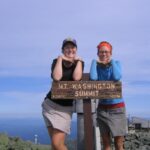
Kathryn hikes with her friend Margaret.
KHP: Morgan, I am curious, if you could relive one single day from your thru-hike, which would it be?
MS: That’s hard to answer because there were so many wonderful days. A memorable moment happened near the end of my journey. During the last hundred miles in New York, my son joined me for a stretch. At a train station in Pawling, a stranger was staring at us, obviously we looked a bit rugged. He then went to his truck and came back with a beautifully carved walking stick and just gifted it to me. He thought I could make good use of it, and I did. Classic Trail magic.
This might not have been my most enjoyable day, but certainly one that I will always remember. On July 4th, we summitted Mount Washington. It was a beautiful, clear day when we arrived. By the time we started heading down, the weather had completely changed into a whiteout.
The wind was so strong that my backpack acted like a sail and literally lifted me a foot off the ground and moved me a few paces!
I’ve heard people talk a lot lately about “Type II Fun.” Kathryn, what was your best Type II Fun moment?
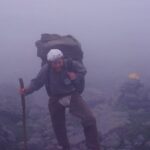
Morgan treks through a windy whiteout.
KHP: Oh, I have a good one!
After taking two zero days in Philadelphia, we returned to the Trail near Fort Clinton during a period of heavy rain. Rivers had swelled so much that we ended up wading waist-deep in water for nearly two miles, following the white blazes on trees as they were just above the water line.
We were already soaked, so we just laughed and accepted our fate. For several days it felt like we would never be dry again. Eventually, we reached a shelter and tried to dry our clothes, or at least the socks. Miraculously, no trench foot!
MS: Oh, I have a good one to share about you!
KHP: *Laughing* Oh no, remember we are supposed to be inspiring folks, Morgan!
MS: Kathryn is the only person I know who is so dedicated to the Trail that she still carries a piece of shrapnel in her shoulder. She even gave it a name, “John Henry.”
It happened during her very first season working on the ATC’s Konnarock Trail Crew. She and another crew member, Josh, were working on a particularly stubborn rock embedded in the tread. Josh gave it a mighty swing with a sledgehammer, and the rock finally gave way, but so did the hammer.
A shard of steel from the hammer head ricocheted and struck Kathryn in the shoulder!

The makings of a life dedicated to the A.T.!
At first no one quite understood what had happened. Later, they pieced the story together by comparing the cracked hammer with Kathryn’s X-ray. The missing fragment from the tool matched exactly what had lodged in her shoulder.
And to this day, that little piece of steel, John Henry, is still with her. It’s probably the most permanent reminder anyone could have of their commitment to the Trail.
KHP: Yeah, those were the types of time you have to rely on your grit and good humor on the Trail!
KHP: As you know, Morgan, the Trail is often described as being the greatest teacher of self-reliance. But did it teach you anything else about yourself?
MS: In 1977 there was absolutely no cell service, so self-reliance was unavoidable.
But one moment really stuck with me. There was a quiet hiker we had been seeing on and off who looked a bit like Jesus. Seriously, the whole look, long hair and beard, etc. He rarely spoke. One evening at a shelter he suddenly looked at me and said, “Morgan, you should never stop hiking the Appalachian Trail.”
Clearly, I took that advice to heart, since I never have. More lessons I think we all inevitably gain from the Trail are: “Just go do it. Be patient. Put one foot in front of the other.”
KHP: Yes! That idea of putting one foot in front of the other really does stay with you.
For me, completing the Trail completely changed the direction of my life. My thru-hike was when I first fell deeply in love with the Appalachian Trail and the natural world around it. Spending that much time immersed in nature reshaped my relationship with it. Even today, when I’m away from the woods for too long, I feel like something is missing.
I didn’t start my hike imagining a career connected to the Trail, but my first job afterward was with the Green Mountain Club, simply because I missed the Trail so much. Over time I realized that helping protect this place, ensuring it exists for everyone, was something I wanted to dedicate my life to.
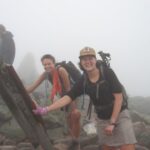
All smiles at the Katahdin sign.
KHP: Morgan, you’ve spent more than four decades working with the ATC. How did being a 2,000-miler influence the way you approached your work?
MS: My first role involved trail acquisition planning, trail design, and volunteer training.
Coming from a family of engineers, hiking the entire Trail was almost like earning a PhD in trail design and construction. I could see what worked, what didn’t, and how hikers actually experienced the footpath. It helped me connect the technical side of trail management with the human experience of being out there.
You see many beautiful things on the Trail, but you also see damaged resources or people making questionable decisions. That perspective helps you think about how to better manage and protect the Trail.
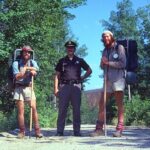
Police stop Morgan due to a forest fire.
KHP: You dedicated your life to the Appalachian Trail and as much as you baulk at our praise and admiration, you truly are a living legend to our ATC team. After celebrating the A.T. and ATC’s Centennial last year, what does the next 100 years mean to you?
MS: What I hope most is that the volunteer spirit continues. The A.T. simply would not exist without volunteers who maintain and care for it. As the hiking community becomes more diverse, I hope that the community of caretakers and maintainers becomes more diverse too.
Above all, I hope that in 100 years the Trail is still as good, or even better, than it is today.
Kathryn, you still have many decades of A.T. leadership ahead of you to follow in my footsteps! In 2056, as you and your team are planning for the start of hiker season once again, what do you hope the Trail will still look like for those next generations?
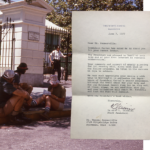
Morgan begins his advocacy journey.
KHP: First of all, I hope I’m still amongst those hikers! My friend Margaret and I still talk about re-hiking the Trail when we retire.
But more than anything, I hope the Trail looks much the same as it does today. As you know all too well, that means protecting the surrounding landscapes, safeguarding water quality, managing invasive species, and continuing to build thoughtful infrastructure so hikers can enjoy the experience without damaging the land.
We have decades ahead of us to continue educating hikers about Leave No Trace and responsible recreation so that the Trail remains both accessible and sustainable.

Kathryn takes in the views along Franconia Ridge.
MS: Well said. I remain optimistic that the A.T. will always be there for all who seek it.
KHP: Morgan, I am so grateful we had this time to reflect together. The Trail has shaped both of our lives in immeasurable ways, and now we share the privilege of helping to protect it.
There is still important work ahead to Keep the Trail Alive. And I know that we both are continually inspired by the thousands of members and supporters who stand beside us as partners in this mission.