
One Year After Hurricane Helene
The Appalachian Trail Conservancy has released an impact report highlighting the emergency response and recovery efforts after Hurricane Helene inflicted the worst damage in the Trail’s history.


For more than a century, the Appalachian Trail Conservancy has led the grassroots effort to care for the day-to-day management of the Appalachian National Scenic Trail. While the A.T. is a unit of the National Park Service, it is a collaborative trail management project that relies on the dedication and commitment of the ATC, A.T. Clubs, and thousands of volunteers in partnership with public land managers.
The endurance of the A.T. experience — with white blazes for navigation and standards of trail maintenance that serve as models for long-distance trails around the world — is a direct result of the ATC’s leadership and expertise in bringing together the entities and individuals needed to sustain a world-renowned Trail.
With trail management program staff working in each of the 14 states through which the Trail passes, the ATC works to carry out essential responsibilities from planning future trail projects and their funding, to supporting A.T. Clubs, and ensuring the Trail experience is as safe, rich and rewarding as possible.

2,197.9
Miles of Footpath

98%
of A.T. on Public Lands

30
A.T. Clubs

5,000
Volunteers

14
States
261
Backcountry Shelters
231
Designated Campsites
316
Privies
The Appalachian National Scenic Trail is unlike any ordinary National Park. It requires an expansive and collaborative approach to management that ensures both local and Trail-wide issues are addressed. The A.T.’s Cooperative Management System (CMS) depends on the ATC, the National Park Service, USDA Forest Service, state land managers, and the local Clubs working together to plan and implement major trail improvements, respond to threats, and create sustainable solutions. The ATC is the unifying entity that convenes the CMS partners to carry out the essential work of sustaining every inch of the Trail.
Learn More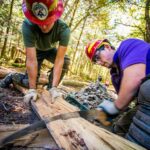
The ATC sets standards for A.T. maintenance, provides training, and supports a culture of safety working in close partnership with land management agencies. ATC-led volunteer trail crews work on larger-scale A.T. relocation, rehabilitation, and construction projects on infrastructure, like shelters, bridges and the treadway between Georgia and Pennsylvania. We also provide training and support for crews in other parts of the Trail and for youth conservation corps working in partnership with Clubs Trail-wide.
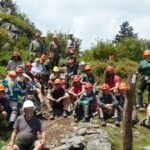
30 A.T. Clubs are responsible for much of the day-to-day work of keeping the A.T. open by mobilizing volunteers to care for their respective trail sections. In addition to Trail maintenance, club volunteers build and repair shelters and bridges, monitor and protect the Trail corridor, monitor rare plants, manage invasive species, develop management plans for their sections, and much more.
Federal and state agencies that manage the lands through which the A.T. courses provide project oversight. The ATC works to enhance the vitality and strength of the A.T.’s collaborative partners by providing capacity support, and resources to meet the unique needs of each partner in realizing their responsibilities to the A.T. and help the Clubs recruit volunteers.
Learn More
From the first blaze painted, to today’s data-informed planning, Visitor Use Management (VUM) guides the Appalachian Trail experience.
Based on Benton MacKaye’s vision of a primitive footpath spanning the ridgeline of the Appalachian Mountains, and informed by the Trail’s designation as a unit of the National Park System in 1968, VUM combines traditional trail stewardship with modern planning, data, and visitor education, to help local ANST managers in making the A.T. and its facilities more sustainable while assuring and protecting the A.T.’s experience.
Learn More
Through the CMS, the ATC leads the collaborative development of policies on issues affecting the Trail — like public safety, visitor use, external threats, and more — and to facilitate consistent management through eight national forests, six national parks, and dozens of state and local jurisdictions.
Learn More
The Appalachian Trail Conservancy (ATC) created the Ridgerunner program in 1986 to further the stewardship and resource protection efforts of the ATC and its affiliated trail club and agency partners by providing an educational presence on the Appalachian Trail (A.T.).
Learn More
The ATC partners with the National Park Service to collaboratively map the Appalachian Trail and its resources.
The geospatial reference resources help plan necessary trail work, track agreements utilized throughout the partnership, and documents the “state of the Trail” for visitors, funders, and lawmakers.
Interactive Map of the A.T.
We’re working to cultivate new generations of people who feel welcome and accepted on the Trail, connected to the resource, and inspired to protect it. The ATC hosts gatherings where young people can learn about conservation and public lands management, pathways for skills development and employment through youth crews, and opportunities for the next generation to provide guidance on how to make the A.T. an improved experience for all.
Learn More
Check out The Register, the ATC’s official blog containing articles about stewardship on the Appalachian Trail.
The Register